Let your teen shop. Keep the boundaries you agreed on.

Set a weekly budget and allowed shops. Your teen sees what they can spend, and you approve exceptions in one tap—without sharing your card or PayPal login.

Signs the rules. Approves in one tap.

Amara, the parent, sees every ask with its budget consequence first.

Open Amara's view
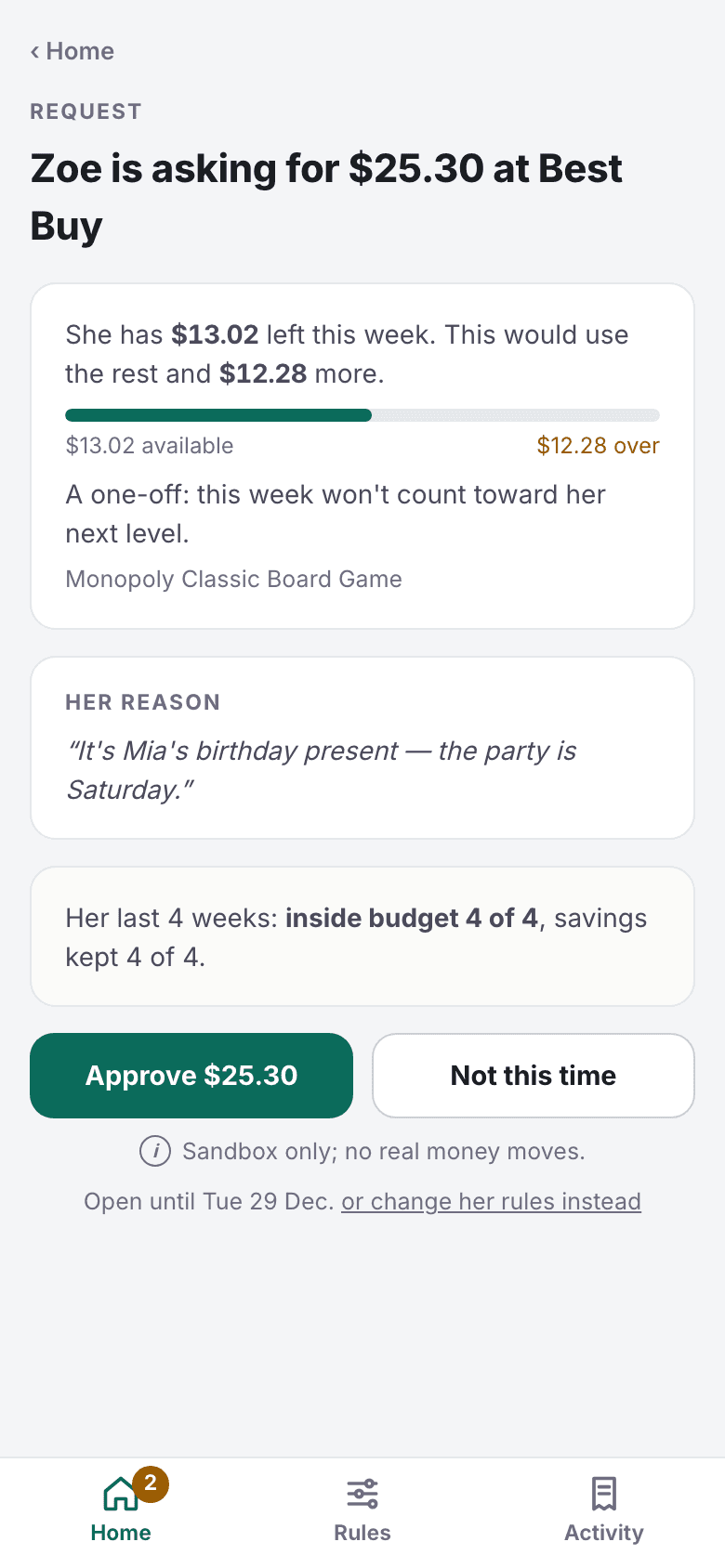
Amara's phone: Zoe is asking for $25.30 at Best Buy. She has $13.02 left this week. Approve $25.30 or Not this time.
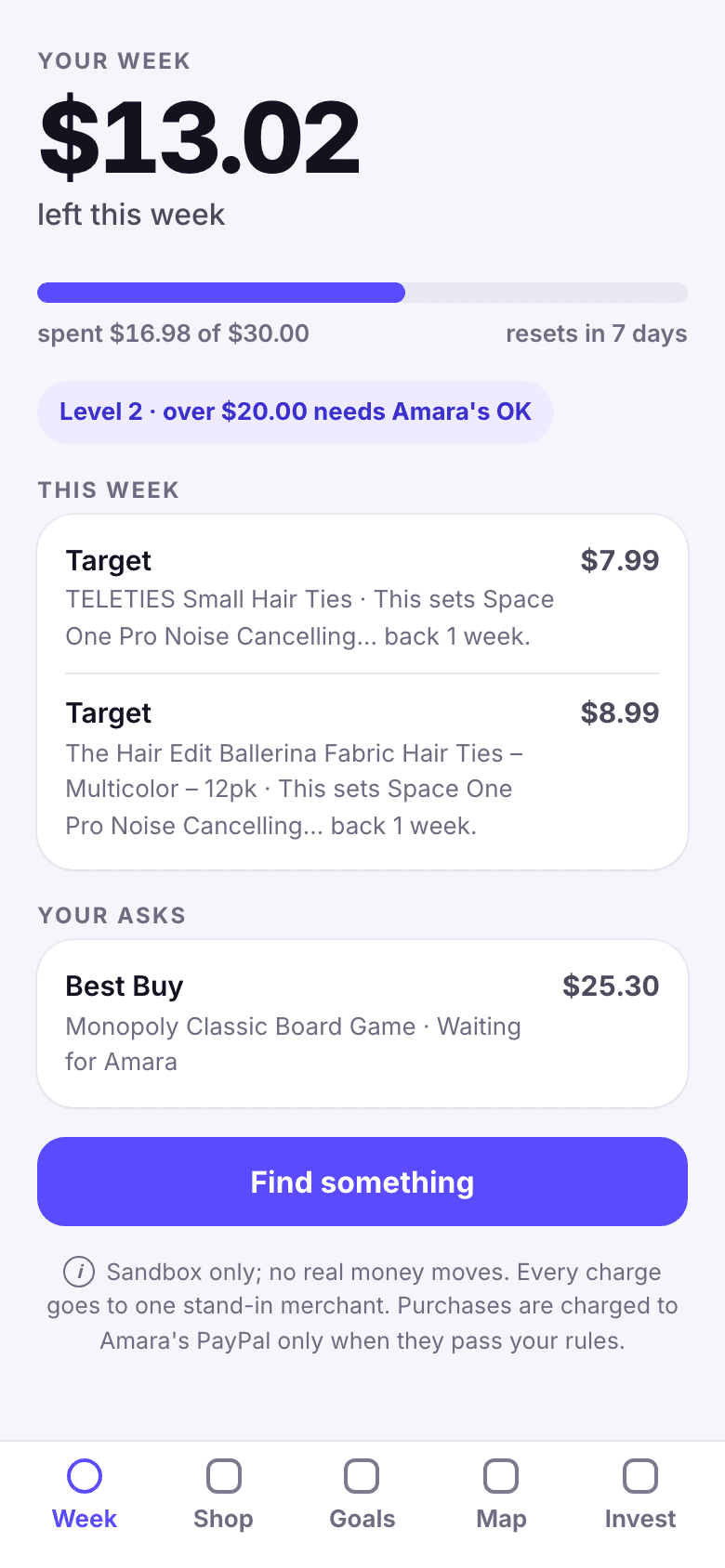
Zoe's phone: $13.02 left this week, Level 2, her Best Buy ask waiting for Amara.

Shops on her own. Asks when she needs more.

Zoe, 15, sees one number for her week: what she has left.

Open Zoe's view

Code checks every cart against her rules

Your teen gets room to act. You don't have to supervise every decision.

Tether lets your teenager shop within limits you set, using your PayPal without sharing your card or login. They see what they have left. Purchases that fit your rules can go through; exceptions come to you with the budget impact clearly explained.

Start your own familyLog in with PayPal. PayPal accounts are for adults, so the parent signs in.

Sandbox only; no real money moves. The demo family is shared and resets itself.

Hand over a card and hope. Or say no to everything.

That's the choice when a fifteen-year-old wants headphones online. Neither teaches her anything.

AI shopping agents make it worse: nobody has settled who is responsible when software spends on someone's behalf.

Tether's answer: the parent writes the rules, the AI only proposes, and plain code decides before PayPal is ever called.

  • Parents$245M

    refunded by Epic Games for children's charges made without a parent's OK. It “ignored more than one million user complaints.” FTC, 2022

    Tether's answer: No card changes hands. Code checks every cart against the rules the parent signed, before PayPal is called.

  • Teens0.1%

    of the differences in money behaviour explained by financial-education classes, across 201 studies. The authors point to “just in time” teaching. Fernandes, Lynch & Netemeyer, 2014

    Tether's answer: A refusal explains itself at the moment she decides, with her real numbers and two ways forward.

  • Saving36%

    of US teens say they save part of the money they get for their future. Junior Achievement & MissionSquare, 2025

    Tether's answer: What she doesn't spend is saved. She sets her own weekly promise, sees the weeks to her goal, and four kept weeks earn her more freedom.

  • Investing70%

    of teens are very or extremely interested in investing. Only 14% say they know a lot about it. Schwab survey, 2025

    Tether's answer: From Level 2: facts only, never daily moves. She gives her reasons in her own words, the parent approves each one, and leveraged products are blocked.

  • Payments and AI$190–385B

    of US online sales could go through AI shopping agents by 2030. Proving who allowed each purchase is still an open question. Morgan Stanley, 2025; Google AP2, 2025

    Tether's answer: The agent only proposes. Each payment carries the rules version and a one-cart permission slip, checkable in PayPal.

Sources and sample sizes

A parent signs the rules. An AI agent proposes. Code decides. PayPal pays.

Two views of one family, both real.

Every screen below is the live sandbox app, captured as it is today.

Rules that read like a contract.

Amara picks a weekly amount, the shops, and how much Zoe promises to save. Zoe reads the same rules in plain words. No AI writes them, and every change is a new version.

  • Shops added or removed with one confirm
  • Level 1 $20 a week, Level 2 $30, Level 3 $50
  • She can stop the rules at once

On Amara's phone
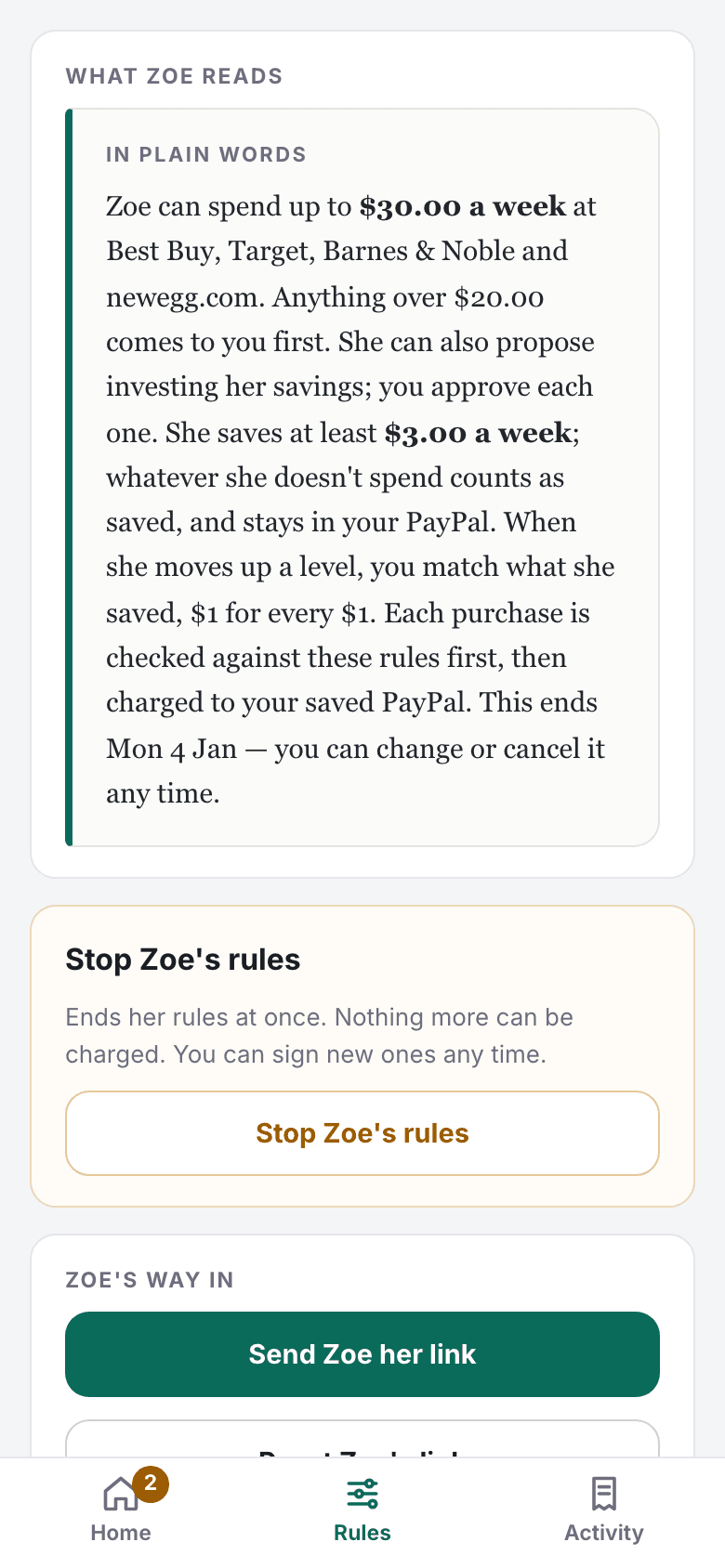
Zoe's rules in plain words, set in a serif like a signed document: up to $30.00 a week at Best Buy, Target, Barnes & Noble and newegg.com.

A shopping agent that can't buy anything.

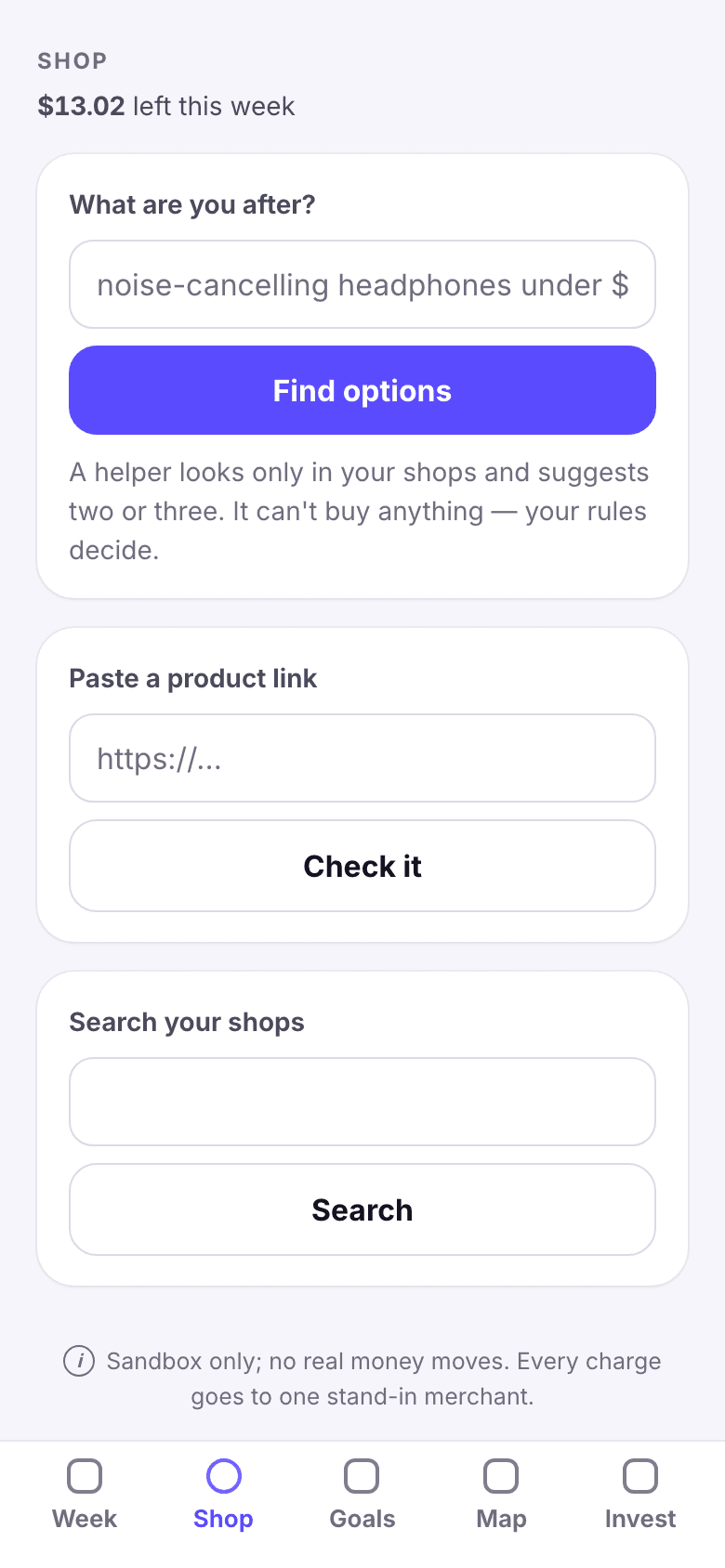
Zoe says what she's after, or pastes a product link. The agent searches only the shops Amara allowed and suggests two or three. Each option carries the rule engine's label: “Fits your week”, “Needs Amara's OK” or “Over budget”.

On Zoe's phone

Zoe's Shop page: What are you after? Find options. A helper looks only in your shops and suggests two or three. It can't buy anything.

A no that teaches.

One plain sentence with the real numbers, and two ways forward. Amber, never red: a refusal is a rule, not a punishment, and never a dead end.

One buzz. One tap.

When Zoe asks for more, Amara gets one notification. It opens the request with the budget consequence first, Zoe's reason, and her last four weeks. Approve checks the rules again, then pays.

On Amara's phone

The request page: She has $13.02 left this week. This would use the rest and $12.28 more. Her reason: It's Mia's birthday present. Approve $25.30.

Freedom she earns, not a limit someone raises.

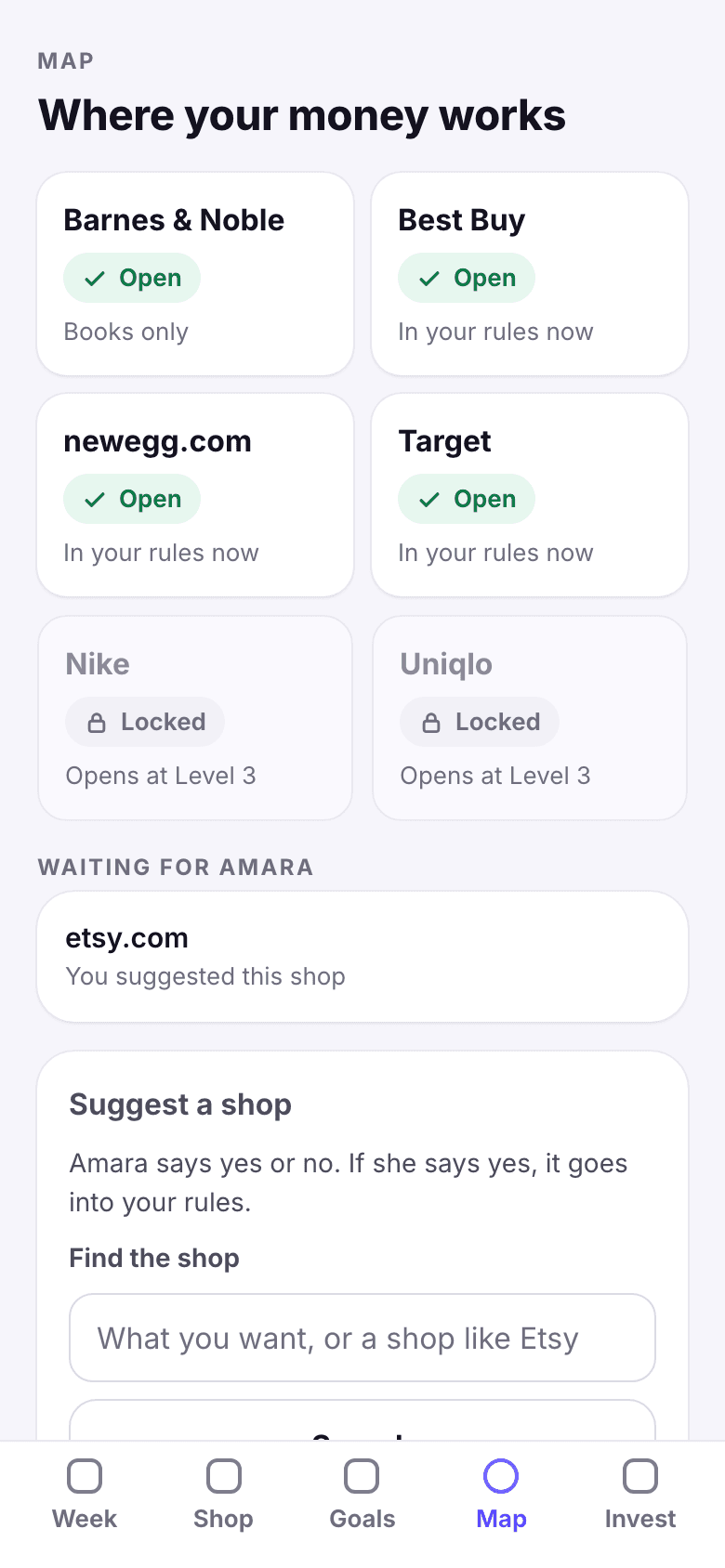
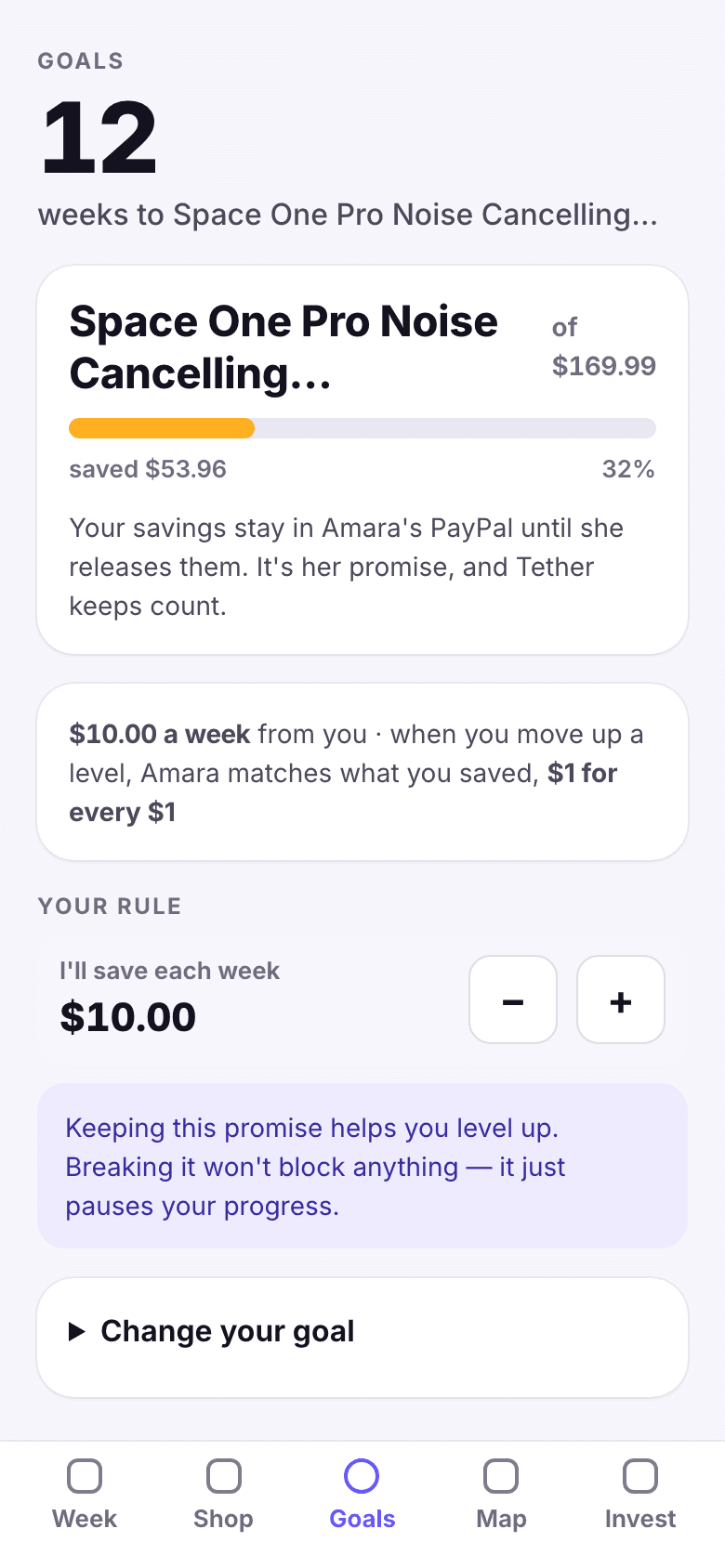
What Zoe doesn't spend is recorded as savings: an amount Amara promises her, paid when Amara chooses. Tether tracks allowance and savings promises. It doesn't hold or set aside money. Purchases charge the parent's saved PayPal when they happen. Four weeks of keeping her own savings promise moves her up a level: more money a week, more shops.

  • Amara's balance runs low? Nothing was reserved, so the promise doesn't change. A purchase PayPal declines charges nothing.
  • She stops? Purchases stop at once and her saved PayPal is disconnected. Savings already recorded stay hers to pay.

On Zoe's phone

Zoe's Map: Barnes & Noble, Best Buy, newegg.com and Target open. Nike and Uniqlo locked, opens at Level 3.
Zoe's Goals: 12 weeks to noise-cancelling headphones, $53.96 saved of $169.99.

Investing with facts, not hype.

From Level 2, Zoe can look up funds or stocks and propose a dollar amount from her savings. Tether recommends nothing, and leveraged products can't be proposed at all. Amara approves each one.

  • What's inside a fund, or what the company does
  • One line against the whole market
  • Three questions she answers in her own words

On Zoe's phone, then Amara's

Ask about the month.

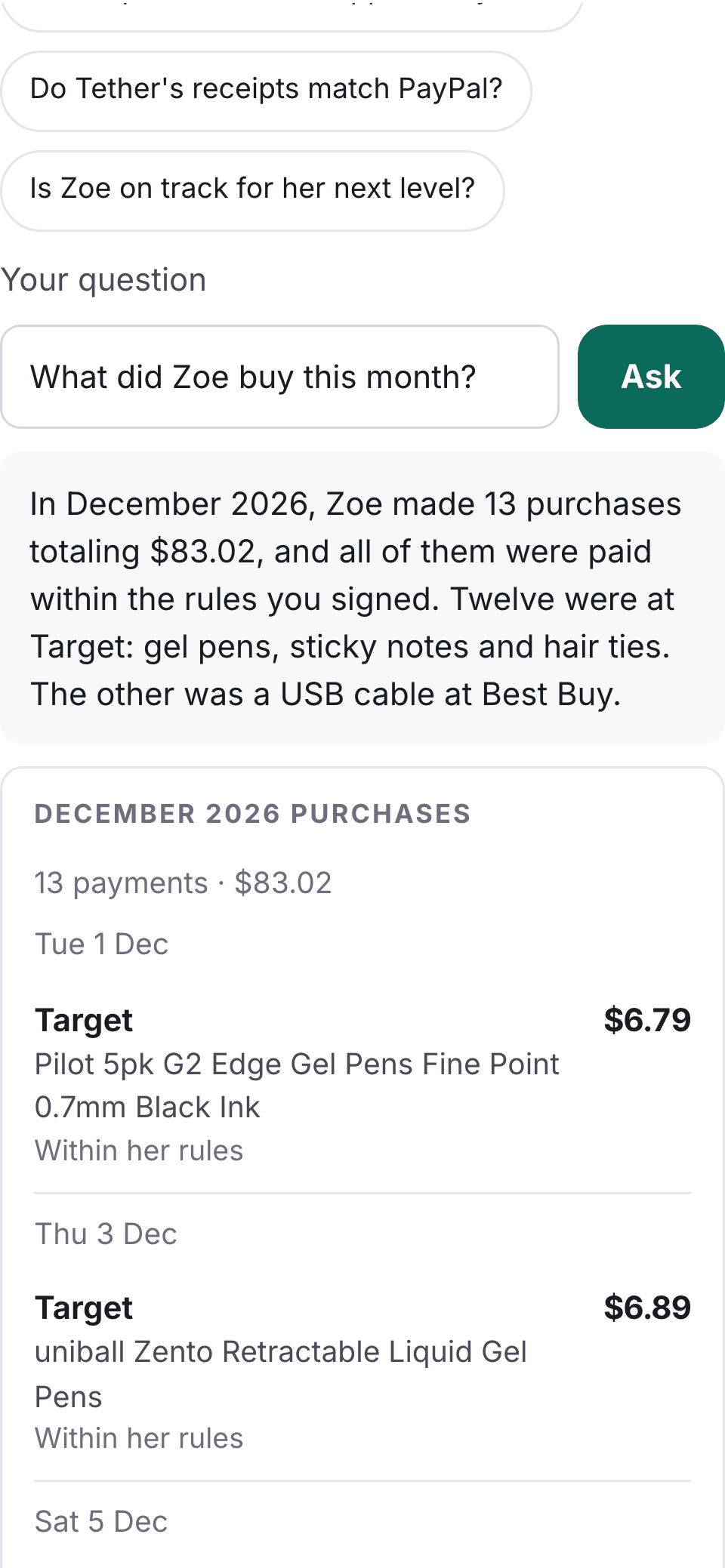
“What did Zoe buy this month?” A read-only assistant answers questions about Zoe's spending, her investments and the news, with cards built from real data, including PayPal's own transaction list through the PayPal Agent Toolkit. It can't move money.

On Amara's phone

The month assistant: In December 2026, Zoe made 13 purchases totaling $83.02, and all of them were paid within the rules you signed, followed by a card listing each purchase.

Four steps. The AI proposes; it never decides.

“A model may add friction. Only code may remove it.”

Amara
1. Amara signs the rulesHow much a week, which shops, how much Zoe saves. Her PayPal is saved once, on PayPal's page.
Zoe
2. The agent proposesZoe asks for something. It searches only her allowed shops and suggests two or three. It can't buy.
Tether code + PayPal
3. Code decidesA rule engine checks the cart. An AI check can only make it stricter.
  • Fits your week: pay now
  • Needs Amara's OK: one tap
  • Not this time: one plain sentence
4. PayPal paysA single-use permission slip, bound to that cart, then one charge to Amara's saved PayPal.

Every weekWhat Zoe doesn't spend becomes her savings.

Four kept weeksKeeping her own savings promise moves her up a level.

From Level 2She can propose investing in funds or stocks. Amara approves each one.

Meet the agents.

Two parts of Tether are agents: a model that loops, calling tools. Three more are single model calls whose answers code checks. Each single call has a plain code fallback, and the rest of the app still works with the model switched off; the month assistant says it can't see the answer right now.

The shopping agent

Claude Haiku 5.5, for Zoe

Zoe types “headphones under $30” or pastes a product link. The agent searches only the shops Amara allowed, in at most 6 tool calls, then proposes two or three carts with a short reason each. Code checks every cart against the signed rules and labels it “Fits your week”, “Needs Amara's OK” or “Over budget” before Zoe sees it.

Its two tools

  • Search the shops Amara allowed, through Channel3
  • Look up a product link Zoe pasted

It can't buy, approve, change a rule or touch PayPal.

The month assistant

Claude Sonnet 5.5, for Amara

Amara asks about Zoe's month, her investments or the news: “What did Zoe buy this month?” It answers in at most 5 steps, from read-only tools. The cards under each answer are built by code from real data, never written by the model.

Its read-only tools

  • Tether's receipts for a month
  • PayPal's transaction list, through the PayPal Agent Toolkit, filtered to this family
  • Whether the month's receipts match PayPal
  • Zoe's level, her week and her next check-in
  • How Zoe's investments are doing
  • What's inside one of her funds
  • Headlines: the market, or a company on her list or inside her funds

It can't move money, advise, predict or rank. Without the data it says “I can't see that.”

Three single calls, each checked by code.

One question in, one answer out, no tools. Code checks every answer, and anything off falls back to plain wording.

  • “Is it really a book?”The bookshop (from Level 2) is for books only, and Barnes & Noble also sells games. The model says how sure it is; code decides. 98% or surer, the cart goes through. From 70%, it needs Amara's OK. Below that, it's refused.An error or no answer within 4 seconds counts as refused. It can only tighten the rules, never loosen them.
  • Refusal sentencesThe rule engine's reasons, turned into one sentence for Zoe with two ways forward. It may use only the dollar amounts the engine gave it, never say a purchase is approved, and is 240 characters at most.Otherwise a fixed template: “You've got $13.02 left this week and this is $25.30.”
  • Fund and company descriptionsOne plain sentence about what a fund or company is, on Zoe's investing screen. The model never sees prices and may write no numbers, comparisons or selling words.Otherwise a template. Every price line is written by code.

Who can touch money.

AIproposes, explains, answers

  • Shopping agent
  • “Is it a book?” check
  • Refusal sentences
  • Fund descriptions
  • Month assistant

Codedecides

  • Rule enginethe rules Amara signed
  • Amara's approvals
  • Permission slipsingle use, 120 seconds, one cart

Moneymoves

  • PayPalcharges Amara's saved wallet
  • Alpacadeposit and order

Nothing in the AI group has a path to PayPal or Alpaca except through code that checks the rules Amara signed, and her approval where they ask for it. The month assistant only reads PayPal's list.

What the AI can do, and what it never can.

It can

  • ProposeTwo or three options, only from shops Amara allowed.
  • ExplainWhy a cart doesn't fit, in one plain sentence with the real numbers.
  • Add frictionAsk “is this really a book?” and hold the cart for Amara's OK, or refuse it. Never the other way.
  • Answer, read-onlyAmara's questions about the month, her investments and the news, from receipts and PayPal's list.

It never can

  • DecidePlain code checks every cart against the signed rules.
  • Loosen a ruleOnly Amara changes the rules, and each change asks her once.
  • Move moneyNo model in Tether has a tool that charges, buys or invests.
  • Recommend an investmentFund and stock pages show facts only. Zoe proposes; Amara decides.

PayPal is where consent is given and where the proof lives.

Zoe never has a PayPal account or a card. Every dollar moves from Amara's own PayPal, and every payment can be checked against PayPal's records.

  • Sign-inLog in with PayPal

    A parent starts a family by logging in with PayPal. PayPal accounts are for adults; Zoe never signs in to PayPal.

  • ConsentPayPal Vault

    Amara saves her PayPal once, on PayPal's own page. Tether never sees her password.

  • PaymentOrders v2

    Each approved cart is one charge to that saved wallet, carrying a single-use permission slip: valid two minutes, bound to that exact cart.

  • ProofTransaction Search, webhooks

    The slip's id travels inside the PayPal order. Tether checks its receipts against PayPal's transaction list and signed webhooks.

  • AI, read-onlyPayPal Agent Toolkit

    The month assistant reads PayPal's transaction list, filtered to the family. It has no tool that pays.

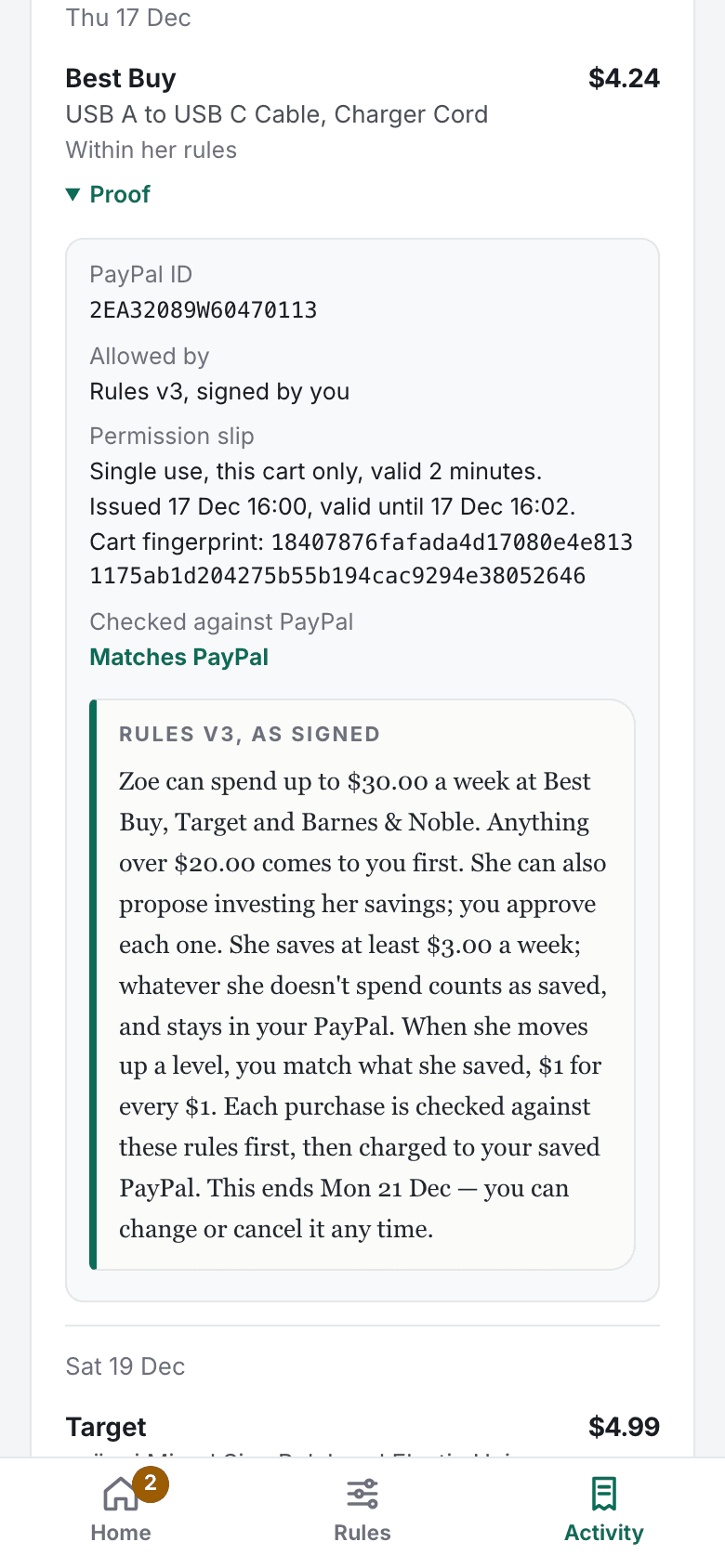
Proof for a $4.24 Best Buy payment: PayPal ID 2EA32089W60470113, allowed by Rules v3 signed by you, a single-use permission slip valid 2 minutes, checked against PayPal: Matches PayPal.
Proof, one tap from any payment: PayPal ID, the rules version, the permission slip, and whether PayPal's records match.

What the sandbox stands in for, said plainly.

In this demoIn production
Every purchase pays one Tether sandbox account; the receipt records which shop it was for.Tether would pay shops through PayPal's platform and agent-checkout programs.
Zoe's investments sit in an ordinary Alpaca sandbox account, labelled on screen as a stand-in.A custodial account Amara manages for Zoe.
A demo clock moves time forward so a month fits in a few clicks.Real time.
The demo family is shared, and resets itself.One family per household.

Questions parents ask.

Straight answers, including what this demo doesn't do yet.

Will my teen's savings still be there if I spend the money in my PayPal?

Not automatically. Savings is a promise Tether records, not money it holds.

Each week, what your teen doesn't spend is recorded as an amount you promise them. Tether doesn't hold, reserve or move that money, and it doesn't check your PayPal balance. If you spend it, their number stays the same, and the promise is still yours to keep.

At the monthly check-in, Tether asks you to pay it out yourself (Venmo, PayPal or cash) and record the payment, so the promise stays small. Money your teen invests is different: with your OK it moves into their own investing account (simulated in this demo).

Can my teen buy something without asking me?

Yes, within the limits you choose. Anything over them comes to you.

You pick one of two ways: “Ask me before every purchase”, or “Up to $___ per purchase at approved shops without asking”. Each level starts with a default you can change: at Level 1 your teen can spend $20 a week, and anything over $10, or at a shop they haven't used, comes to you first. At Level 2 it's $30 a week, and anything over $20 comes to you. At Level 3 it's $50 a week, and nothing inside their shops needs your OK. A level change never loosens the limit you chose.

Every purchase counts at its estimated full cost: the price plus your sales tax and shipping estimate. It gets a single-use permission slip, and code re-checks your rules before PayPal is charged. The AI can suggest; it can never approve. Pause spending makes every purchase wait for your yes until you resume; Stop ends the rules entirely.

What happens when an order is canceled or refunded?

If PayPal declines, nothing is charged. A store refund comes back to your teen.

If PayPal declines a payment, nothing is charged and the money goes back into your teen's week. When a store refunds a purchase, Tether finds it in PayPal's own records and returns it once: back into this week if the week is still open, otherwise added to what you've promised. The receipt says which, for example “Refunded in PayPal · $15.00 back to Zoe's week”.

In this demo every purchase pays one stand-in shop, so there's no real shipping and nothing to return; shipping and tax are estimates you set. In a real launch, the store ships and handles returns under its own policy, and its refund comes back to your PayPal.

What happens when my teen wants something from a store Tether doesn't support?

They can't buy it through Tether, but they can ask you.

Your teen's shopping agent only searches the shops you've allowed, and more kinds of shop open as they level up. It only suggests items those shops list as in stock. If they want something their rules can't pay for, they can send you an ask, and nothing is charged. You can add a shop from the rules page.

In this demo, purchases go to one stand-in merchant. A real launch needs each store's own checkout.

Who can see my teen's information, and can I delete it?

You and your teen. In this demo, a family is removed after 7 days.

  • Who sees it: you, signed in with PayPal or through your private link, and your teen, through their own link. Their link works like a key: you can reset it, and the old one stops working.
  • What's stored: your teen's first name, their rules, asks and purchases, and your PayPal account ID, email and first name. No analytics or ad tracking.
  • What leaves Tether: shopping requests and your questions to the month assistant go to Anthropic's Claude; product searches go to Channel3; payments go to PayPal; notifications go through OneSignal. In this demo, the investing account at Alpaca uses made-up identity details; only your teen's first name is real.
  • Deleting: 7 days after it starts, this demo removes the family. Both links stop working, the names and your PayPal details are wiped, and your saved PayPal is deleted. The money record (purchases, asks, savings) is kept, because it's the proof of what happened and can't be edited. A real launch would add export and full deletion.

Try it in five steps.

  1. Open Zoe's view. Her week shows one number: what she has left.
  2. In Shop, ask for something, like “headphones under $30”. Open an over-budget option to read its sentence and two ways forward.
  3. Open Amara's view. Home shows what needs her. Open Zoe's ask and approve it.
  4. In Activity, open Proof on that payment: PayPal ID, permission slip, rules version.
  5. Ask the month assistant “What did Zoe buy this month?”
Open Zoe's viewOpen Amara's view

Sandbox only; no real money moves. Anyone can use the demo family, and it resets itself.

Start your own family

Log in with PayPal, add your teen, sign the first rules. About three minutes.

Sandbox PayPal only: log in with the sandbox account above, never your real one. New families are removed after 7 days.